Away Team Equipment
Created by Captain Emiul Thikaik on Wed Feb 25th, 2026 @ 4:00am
Starfleet Equipment
Standard Equipment
Phaser
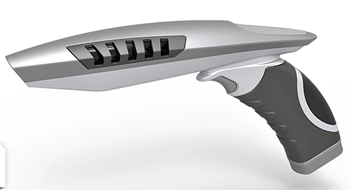 The 32nd Century Phaser serves as the standard defensive sidearm for Starfleet away missions, representing the pinnacle of phased energy rectification technology. Although the fundamental technology of Phasers and Disruptors remains practically unchanged from centuries past, these refined counterparts have become significantly more power-efficient and adaptable over time. Advances in weapons design leading into the late 32nd Century were driven by necessity in the aftermath of the Burn, reflecting a return to a militaristic footing in the face of numerous dangers to what remained of the Federation. This model, which entered service by 3189, continues the rugged, industrialized "pistol" configuration. In a significant advancement for the era, the weapon is constructed entirely of programmable matter, allowing it to be extended with little effort to become a Phaser Rifle. This graceful combination of a rifle and a pistol creates a versatile weapon system, allowing an officer to switch between modes to bring to bear proportional responses to all manner of threats.
The design of this more aggressive-looking weapon echoes elements from several earlier eras of Starfleet history, including standard handgrip models and the lower-profile designs of the mid-24th Century. It features a distinctive matte metallic finish and a long, angled handgrip that ensures a firm, steady grip. The trigger is a large, touch-sensitive panel located at the head of the handgrip and is operated by the forefinger. A simplified control interface is positioned on the side of the weapon to allow for the selection of power levels and beam width even in high-stress environmental conditions, while heat dissipation is managed through a series of five distinct cooling vents located along the dorsal surface of the barrel. In addition to its normal range of power settings, the Phaser can be configured to serve as a field-expedient Dermal Regenerator to render emergency first aid.
A major shift in the deployment of this sidearm is the integration of programmable matter with ever-evolving Transporter, replicator, and holographic technology. While some pre-manufactured weapons are carried in starship and starbase armories, it is no longer necessary for personnel to draw them from a physical locker. Instead, the programmable matter is normally stored within a small cuff or pendant worn on the sleeve or wrist of the user’s uniform. The Phaser deploys instantly when the user performs a simple motion that mimics the act of drawing a holstered weapon, allowing for the carrying of sidearms without detection into any number of situations. Internally, the weapon utilizes the rapid nadion effect through four reinforced prefire chambers, allowing for a 15% increase in energy density and plasma pressure compared to earlier handheld models.
The Phaser incorporates advanced genetic profiling and a code processor to ensure the weapon only operates for its designated user, and unauthorized attempts to fire the device result in a localized stun pulse. A built-in Subspace Transceiver Assembly (STA) maintains a constant link with the ship's main computer, which can remotely cap Phaser output to stun levels. To prevent enemy adaptation, internal circuitry continually rotates energy modulation frequencies. Users can select from a variety of power levels ranging from light stun to full disintegration, utilizing multiple discharge modes including pulse, beam, and continuous fire. In terminal scenarios, safety interlocks can be bypassed to initiate a controlled 30-second overload, turning the unit into a makeshift explosive.
Tricom Badge
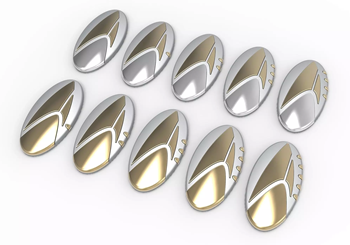 The Tricom badge represents the pinnacle of Starfleet’s integrated personal technology, fundamentally redefining the relationship between an officer and their equipment. By the late 32nd century, this device became standard issue, successfully consolidating the functions of five previously discrete tools (the Communicator Badge, the Tricorder, the Personal Access Display Device (PADD), the Universal Translator, and the Transporter) into a single, compact aesthetic form worn on the uniform's left breast. This integration was driven by the necessity of long-range exploration and the high-stakes environments of the post-Burn era, where the efficiency of "one device for all tasks" became a matter of survival. Unlike the duranium-cased handhelds of the past, the Tricom utilizes sophisticated holographic projectors and programmable matter to provide a limitless interface that adapts to the specific needs of the wearer, whether they are a Field Medic, a Tactical Officer, or a Planetary Surveyor.
The user interface of the Tricom badge relies on a complex system of tactile taps, voice commands, and kinetic hand gestures designed to prevent accidental activation while allowing for rapid deployment in the field. Communicator functions were activated by calling out the name or general area of the intended recipient and then deactivated by issuing the command "Out." To access the holoPADD features, for instance, a user must perform a specific sequence: forming a fist and then opening the palm upward to manifest a hovering holographic interface. This virtual display maintains the high-capacity processing and data-transfer protocols seen in past models, but eliminates the physical weight and power constraints of traditional sarium cells. Similarly, the Tricorder functions are activated through a "squeeze and pull" gesture. This calls forth a comprehensive scanning suite capable of geological, meteorological, and biological analysis, projecting three-dimensional data directly into the user’s field of vision for real-time interpretation.
One of the most radical advancements embodied by the Tricom badge is the integration of a portable Transporter system. This technology enables point-to-point beaming without the historical reliance on a starship’s Transporter Room or a dedicated Transporter Chief to manage the materialization process. By tapping the badge once, the user generates a holographic coordinate grid; once the target is selected and the badge is tapped again, the system initiates the matter-stream disassembly and reassembly process. For emergency situations, the device features a "home" function - activated by a rapid double-tap - which instantly returns the user to a pre-set safe coordinate. This functionality represents a monumental leap over Emergency Transporters, which were often restricted to 15,000 kilometer ranges and limited by pattern buffer degradation.
Beyond its technical utility, the Tricom badge serves as a vital component of Starfleet’s personnel and security infrastructure. The device is the primary display for an individual’s rank, incorporating pips and insignias directly into the Starfleet delta design, with variations specifically tailored for cadets at Starfleet Academy and the Starfleet War College. Security is maintained through a combination of sophisticated encryption algorithms and biometric verification. Utilizing dermal sensors, the badge monitors the wearer’s bioelectrical field and temperature profiles, ensuring that its powerful functions cannot be exploited by unauthorized personnel. In an era where communication with a starship might be interrupted, the badge’s independent internal computer ensures that the officer remains a self-sufficient unit, capable of performing complex scans and maintaining a defensive posture in any environment.
Uniform
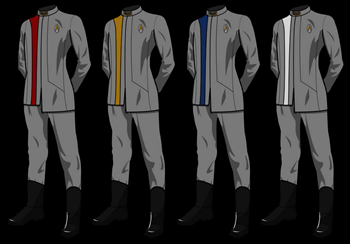 The Starfleet Working Uniform is a specialized, high-durability garment engineered for high-intensity environments, combat scenarios, and hazardous duties where standard duty attire would be impractical. This uniform is crafted from a high-density, heavy-duty fabric specifically designed to resist snags, tears, and abrasions from jagged machinery or environmental hazards. Additionally, the textile composition provides integrated flame resistance, offering a critical layer of thermal protection for engineers and security teams.
The uniform's color palette features a base of slate gray and was strategically selected to mask the inevitable grease, dirt, and wear accumulated during industrial or tactical assignments. Unlike more formal duty variants, the Working Uniform is strictly limited to a trouser-and-jacket configuration to maximize mobility and safety, paired with reinforced black safety boots as standard issue. The jacket itself features a split cowl collar and a slightly diagonal zipper closure that runs from the left side of the collar down the torso.
Departmental identification is intentionally subtle on this variant and is limited to a vertical stripe on the right side denoting departmental color. Current departmental colors include:
- Command: Denoted by a deep red stripe.
- Operations: Denoted by a mustard gold stripe.
- Sciences: Denoted by a navy blue stripe.
- Medical: Denoted by a white stripe.
Categories: No categories found