Secondary Locations
Created by Captain Emiul Thikaik on Sun Feb 22nd, 2026 @ 10:57pm
Command Facilities
Battle Bridge
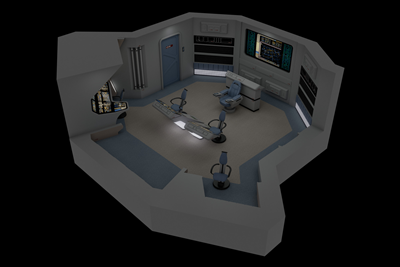 Located on Deck 7, the Battle Bridge serves as the primary auxiliary control center aboard the Crossfield III Class. While compact, these facilities are designed with tactical performance as the absolute priority, maintaining simplified versions of the standard workstations found on the vessel’s Main Bridge. These supplemental command centers are engineered to ensure the entire starship can be controlled from a single, reinforced location in the event that the Main Bridge or Engineering are incapacitated.
The central area of the Battle Bridge provides seating for the Commanding Officer and incorporates control interfaces identical to those of the Captain's Chair on the Main Bridge. Positioned directly forward and to the right of the Command Chair is a freestanding Science station, while the Helm station is located to the left of this central hub. For combat coordination, a freestanding Tactical station is positioned directly behind the Captain's Chair, supplemented by a secondary wall-mounted Tactical console for complex fleet engagements. At the front of the compartment, a modestly sized viewscreen is flanked by an Engineering station on the right and an Operations station on the left.
Entry to the Battle Bridge is achieved through two primary doors located at the rear of the room. Because the vessel can be fully operated from this room alone, the ship's computer conducts mandatory biometric scans to verify authorization before granting access. To ensure rapid deployment during a crisis, an Emergency Turbolift is located in the immediate vicinity of the entry doors.
Executive Conference Room
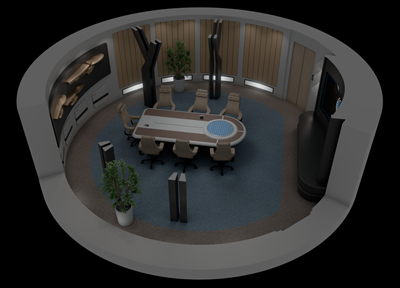 The Executive Conference Room, also frequently referred to as the Observation Lounge, serves as the premier diplomatic and strategic meeting space aboard the starship. Situated on Deck 2, this facility provides a high-level sanctuary for the Senior Staff to formulate plans, report findings, and evaluate mission status in a focused environment free from the distractions of standard duty stations. In a design choice that offers a layer of physical and psychological separation from the high-pressure environment of the Main Bridge, the room is not directly connected to the Crossfield III's command center, requiring personnel to travel away from the Bridge for meetings unlike most other Starfleet designs.
The room’s aesthetic is defined by its structural grandeur, featuring decorative support braces that sweep upward from the perimeter to converge above the central table. The chamber is anchored by a long, polished conference table with seating for up to nine personnel, including a designated chair at the head of the table for the presiding officer. This table functions as a sophisticated computer terminal, equipped with inset consoles and a central tabletop holo-projector capable of displaying mission-critical telemetry and visual evidence. These displays work in synchronization with a large, high-resolution viewscreen positioned at the end of the room, which serves as the primary focal point for presentations and subspace communications.
A significant feature of the Executive Conference Room is the "lineage display" housed against a recessed bulkhead. This display contains highly detailed gold models of previous Federation starships, honoring the historical legacy of Starfleet. The room is further softened by the inclusion of organic elements, such as various species of flora, which assist in maintaining air quality and psychological well-being during long-duration negotiations or sensitive diplomatic receptions. This combination of artistic heritage, advanced technology, and strategic isolation makes the conference suite an essential component of the ship’s ability to function as an efficient deep-space explorer.
Staff Office
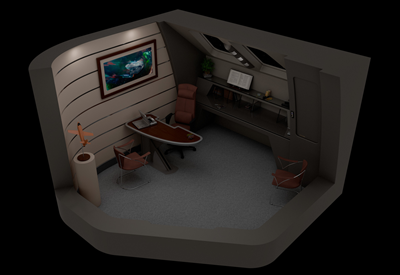 Standardized administrative and departmental offices aboard the Crossfield III Class offer functional, localized workspaces for senior staff, department heads, and visiting dignitaries. Designed with an emphasis on compact efficiency, these offices optimize limited hull real estate while providing an insulated environment for private consultations, administrative duties, and record reviews.
The primary focal point of the office is a wall-anchored executive desk positioned adjacent to the compartment’s bulkheads. The workspace is outfitted with a streamlined desktop interface console allowing the occupant to manage personnel logs, access secure departmental telemetry, or coordinate subspace communications. Directly behind or adjacent to the primary desk, a pair of angled viewports provides external visibility, casting natural starlight across the workspace. An enclosed storage locker, secured via a localized access keypad or biometric sensor, is integrated into the bulkheads for sensitive physical media and equipment.
Unlike expansive flag officer suites, these standard offices prioritize efficient seating over sprawling lounge areas, featuring a primary command chair along with guest seating for private performance reviews or officer briefings. Extended built-in shelving runs beneath the viewport alcove, offering ample space for physical technical manuals, mission logs, and personal items. Curved accent paneling on the main bulkhead provides a dedicated display area for mission artwork, divisional heraldry, or personal mementos, ensuring that each office can be tailored to the individual officer while maintaining Starfleet’s architectural standards.
Operations Facilities
Cargo Bay
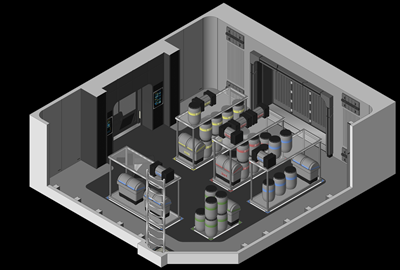
The Cargo Bay, also referred to as a Cargo Hold, serves as the general-purpose storage facility aboard the Crossfield III Class. Distributed across multiple decks, these bays are primary hubs for managing mission-critical goods, planetary deliveries, and the vessel's own internal ship's stores. Due to the expansive and modular nature of these compartments, they are designed for rapid conversion during ship-wide emergencies, frequently serving as secondary triage centers, temporary brigs, or specialized stasis unit facilities.While the Crossfield III utilizes its three main Transporter Rooms for high-capacity transit, several Cargo Bays are equipped with dedicated Cargo Transporters to facilitate the direct transfer of supplies at a molecular resolution. Many of these facilities feature large atmospheric force-field-protected doors that open directly into space, allowing Workbees and shuttlecraft equipped with cargo management units to fly into the bay for immediate offloading. For internal logistics, personnel utilize anti-gravity units and localized Tractor Beam Generators to maneuver heavy containers with minimal effort. A sophisticated cargo conveyor system further optimizes efficiency by connecting the forwardmost holds to those in the aft sections of the ship.
 |
 |
Computer Cores
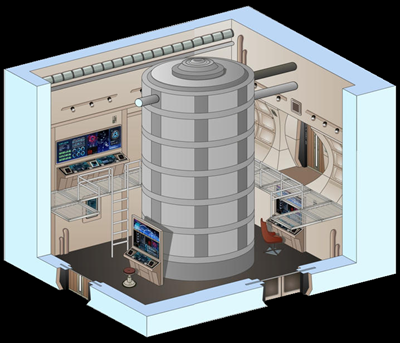
The Crossfield III Class starship utilizes a sophisticated distributed computing architecture consisting of three primary processing cores to manage the vessel's immense data requirements. These cores serve as the central nervous system of the ship, overseeing everything from library computer access to the complex calculations required for Spore Drive Navigation and Tactical Systems.The Saucer Module contains a single, massive Computer Core assembly that serves as the primary data hub for the ship's command and habitable sections, spanning Decks 5 through 7. This vertical, cylindrical housing contains thousands of processing clusters designed for high-speed information retrieval. The core is surrounded by a multi-level maintenance gallery, allowing technicians to access individual processing slices for hardware upgrades or repairs without taking the entire system offline. A dedicated monitoring console is located at the base of the core, with secondary diagnostic stations positioned on the upper gallery to provide real-time telemetry on processor heat levels and data throughput.
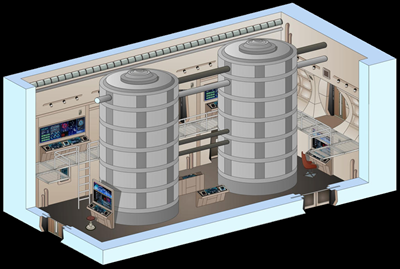
To provide redundancy and handle the high-energy data processing required for the Propulsion Systems, the Engineering Module is equipped with a twin-core assembly spanning Decks 9 through 11. This configuration features two identical processing cores situated in parallel within a reinforced engineering vault. The twin design allows one core to be taken offline for a total system reset or software patch while the other maintains all critical ship functions without a loss of service. These cores are cross-linked via high-speed optical data trunks, ensuring that the engineering and saucer modules can share data instantaneously or operate independently if the ship undergoes saucer separation.
The Saucer Core is primarily dedicated to command and habitation functions across its two-deck span. In contrast, the Engineering Cores provide essential propulsion data and system redundancy across Decks 10 and 11. While the saucer core relies on an integrated gallery for maintenance, the engineering cores offer dual-core access to ensure continuous operation during technical overhauls.
 |
 |
Transporter
Overview
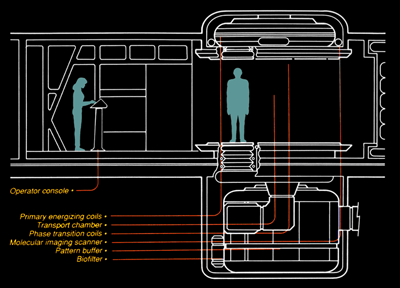 The Transporter, originally pioneered by Emory Erickson, remains the primary method for personnel and equipment to travel between a starship and other locations without the use of small craft. While the core principle of dematerializing an object into a subatomic matter stream and rematerializing it via a subspace carrier wave remains unchanged, 32nd Century technology has significantly advanced the hardware. Unlike the stationary platforms of the 24th Century, modern systems often utilize programmable matter and integrated commbadge transporters, though dedicated Transporter Rooms still serve as high-capacity hubs.
Standard Personnel Transporters operate at quantum-level resolution, which is essential for the safe transport of living beings, whereas Cargo Transporters are generally optimized for molecular resolution to conserve energy. These systems typically maintain an operational range of approximately 40,000 to 100,000 kilometers depending on power availability. Emergency transporters, such as those aboard the Crossfield III Class, utilize scan-only phase transition coils designed exclusively for rapid evacuation. These units operate at reduced power with a limited range of roughly 15,000 kilometers but offer a higher throughput for moving large numbers of people during crises.
The Transport process relies on primary energizing coils to create an Annular Confinement Beam (ACB), which establishes the spatial matrix for dematerialization. A secondary field holds the subject within this matrix to prevent catastrophic energy discharges. During transit, the matter stream is held in a Pattern Buffer (a superconducting tokamak device that allows Doppler compensators to adjust for relative motion between the ship and the destination). In emergencies, these buffers can safely suspend a pattern for up to 420 seconds before irreversible image degradation occurs.
Modern security protocols are managed by integrated Biofilters and Molecular Imaging Scanners. The Biofilter automatically scans incoming matter streams to detect and remove dangerous viral or bacterial agents, while scanners verify the quantum state of the subject to ensure accuracy. Transporter specialists monitor these functions from a control console, where they can manually override automated sequences or bypass safety protocols with command authorization.
Despite these advancements, Transporters remain susceptible to interference from dense minerals, solar flares, and high-energy subspace phenomena. Deflector Shields and Cloaking Devices still prevent standard Transport operations unless specialized techniques, such as shield modulation matching or tachyon emission, are employed to penetrate the barrier. In the 32nd century, the integration of transporters into personal wearable technology has made "site-to-site" Transport the standard experience, though it requires nearly twice the energy of a platform-based beam-out because it necessitates a double-beaming procedure through the ship's buffers.
Transporter Room
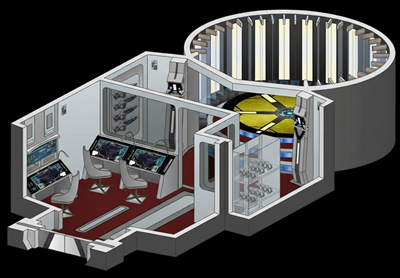 The Crossfield III Class is equipped with three dedicated Transporter Rooms, which serve as the primary facilities for high-capacity personnel and cargo transit. Overseen by a Transporter Specialist, each room is designed around a circular Transporter Chamber featuring a slightly elevated platform. The platform is fitted with six individual pads, which are utilized for personnel transport, while the expansive central section is reserved for beaming large pieces of cargo or equipment to and from the vessel. The chamber is illuminated by vertical light panels along the rear bulkhead and a glowing overhead array containing the primary energizing coils and molecular imaging scanners.
Situated opposite the chamber, the Transporter Specialist operates from a large, angled display console located within a semi-enclosed command alcove. This station allows the chief to verify coordinate locks, monitor environmental data from targeting scanners, and manage the autosequence programs that handle the intricate materialize/dematerialize cycle. A secondary monitoring console is integrated into the bulkhead behind the main operator, providing a comprehensive status overview of the system’s Heisenberg Compensators and pattern buffers. In high-stress scenarios, such as a large-scale evacuation or an emergency beam-in directly to Sickbay, a second technician can utilize this wall console to provide critical support and fine-tune system components.
Access to the facility is provided through a main entry door that leads into a staging area where Away Teams can conduct final briefings. This anteroom includes a specialized equipment bay and a glass-fronted storage locker where personnel can check out gear, such as phasers and tricorders, for their assignments. Adjacent to this storage area is a secure circuitry bay that houses the core hardware of the Transporter system, including the Biofilters and access panels for the Pattern Buffer tanks located on the deck below. By centralizing these components in a locked, easily accessible compartment, technicians can perform rapid modifications or repairs to the system’s quantum-level resolution hardware without disrupting the main Transporter Chamber.
Tactical Facilities
Armory
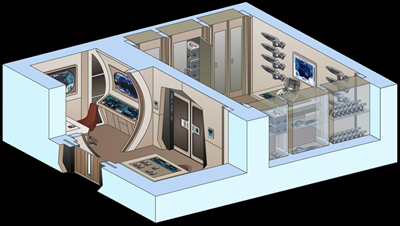 The Armory aboard the Crossfield III Class serves as the high-security staging and storage hub for the vessel's personal weaponry and tactical equipment. Designed for rapid response and efficiency, the facility is divided into two distinct functional zones separated by a structural bulkhead and heavy security doors. The primary administrative area features an L-shaped monitoring console where a Security Officer manages the armory's inventory and monitors ship-wide tactical sensors. This section is equipped with several wall-mounted displays and a dedicated workstation, ensuring that the Armory remains a focal point for internal defense operations.
Adjacent to the duty station is the primary storage vault, a reinforced compartment containing rows of specialized glass-fronted cabinets and open-access wall racks. These units are meticulously organized to house a wide array of Starfleet-standard equipment, including hand Phasers, Phaser Rifles, and related weaponry. The facility also features vertical storage lockers for environmental suits and heavy-duty combat gear, ensuring that away teams can be fully equipped for any planetary or boarding contingency. For added security, a localized forcefield generator and biometric verification systems are integrated into the vault's entrance to prevent unauthorized access to the lethal ordinance contained within.
Brig
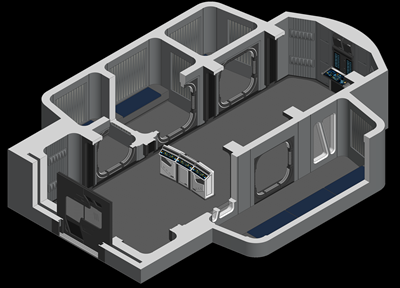 The Brig on the Crossfield III Class serves as the primary detention facility within the Security Section, designed to house criminals, fugitives, or individuals deemed a danger to themselves or the ship’s complement. Heavily guarded and strategically segregated from the ship’s primary habitation hubs, the Brig is engineered for total containment and maximum surveillance.
The Brig is a single-level facility featuring a central corridor that separates the various detention units. A primary security console is positioned in the center of the room, parallel to the main entrance, allowing the duty officer to manage the advanced security sensors that monitor each occupant's vitals and threat level in real-time. This console also controls the internal forcefield arrays and atmospheric regulators for the entire suite. The structural layout includes three individual cells located on the port side of the room, while a single, elongated holding cell is situated on the starboard side to accommodate groups of prisoners or high-volume transfers.
The cells are functionally designed, prioritizing security over comfort, and are constructed with rodinium-reinforced bulkheads to withstand any physical escape attempts. Each cell contains a single bunk integrated directly into the bulkhead, serving as the sole concession for prisoner comfort. Forcefield generators are embedded into the cell door frames, creating an impenetrable barrier that is managed via a dedicated keypad interface built into the surrounding bulkhead for localized control by security personnel.
Classified Material Vault
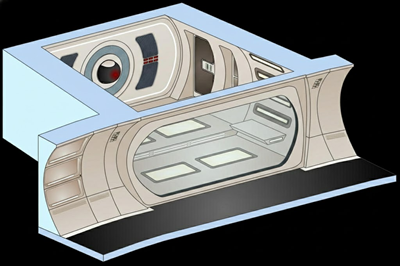 The Classified Material Vault aboard the Crossfield III Class serves as the most secure repository for sensitive physical data, recovered artifacts, and restricted intelligence materials. To ensure the integrity of the contents, the vault is located deep within the ship’s stardrive, far from external bulkheads and high-traffic crew areas. The facility is characterized by a specialized containment chamber featuring reinforced, transparent partitions that allow for visual inspection of stored items while maintaining a total environmental and security seal.
The interior of the vault is equipped with high-intensity floor emitters that provide focused illumination and can be configured to emit localized stasis fields or decontamination radiation as required by the nature of the stored material. A primary security interface is integrated into the rear bulkhead, featuring a prominent red ocular sensor that conducts continuous biometric and multi-spectral surveillance of the chamber's interior. This system is cross-linked directly with the ship's main computer and the Security Department, ensuring that any unauthorized attempt to access or tamper with the materials triggers an immediate ship-wide alert.
Access to the vault is restricted to the Commanding Officer, Executive Officer, and designated personnel through a multi-factor authentication process. The entry sequence requires simultaneous biometric scans and a rotating encryption key provided by Starfleet Command. Because of its critical role in protecting Fleet secrets, the vault is protected by a dedicated independent power cell and localized structural reinforcement, ensuring the materials remain contained even in the event of a total ship-wide power failure or significant hull damage.
Phaser Control Room
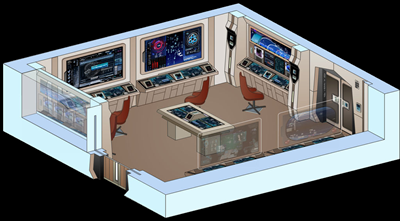 The Phaser Control Rooms aboard the Crossfield III Class serve as the primary tactical hub for the management and oversight of the ship's Phaser arrays. Functioning as a specialized annex of the Tactical Department, this facility provides a high-resolution interface for the precise calibration of Phaser frequencies and the coordination of the vessel's rapid-fire defensive systems. The room’s layout is designed for maximum situational awareness, featuring a series of wall-mounted strategic displays and angled control consoles that provide real-time telemetry on Phaser Bank energy levels and targeting sensor accuracy.
A central, free-standing tactical table acts as the room's focal point, offering a three-dimensional holographic representation of the surrounding environment and current engagement envelopes. Surrounding this central hub are multiple dedicated duty stations, each equipped with ergonomic seating and high-capacity data terminals, allowing personnel to work in unison during complex combat maneuvers. The facility is further enhanced by glass-enclosed equipment racks that house localized redundant processors and power relays, ensuring that the Phaser Arrays remain operational even if main power to the Bridge is disrupted.
Access to the Phaser Control Room is secured by heavy biometric-locked doors, given the sensitivity of the offensive systems managed within. The interior architecture utilizes reinforced bulkheads and integrated overhead lighting, maintaining a functional and focused environment for the tactical crew. In addition to active combat management, the room is used for daily diagnostic sweeps of the Phaser Emitters and for conducting simulations of advanced firing patterns.
Torpedo Bay
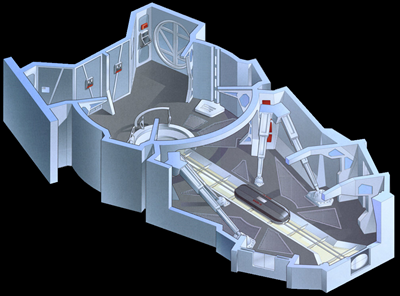 The Torpedo Bay aboard the Crossfield III Class serves as the primary storage and deployment hub for the vessel's Photon and Quantum Torpedo complements. These bays are highly automated facilities, though they retain the capacity for manual overrides and physical modifications to the launchers if automated systems fail. The structural layout of the bay is characterized by a long, narrow configuration designed to facilitate the rapid movement of ordnance from the storage magazines into the primary launching mechanisms. To ensure the survival of the ship's offensive capabilities during combat, each bay is heavily reinforced by the vessel's primary armor plating.
Within the bay, Torpedoes are lowered into the loading area where personnel can perform final diagnostic checks or warhead calibrations before the launch sequence initiates. Once prepared for deployment, the Torpedo is transferred onto a launch track recessed into the deck plating, which guides the unit toward the forward or aft launch tubes. The launching system utilizes a series of articulated mechanical arms to precisely position the ordnance within the tube assembly. This assembly is separated from the main bay by an inner pressure door designed to shield the crew from the intense plasma exhaust generated by the Torpedo's propulsion systems. When firing, the outer hull doors retract, allowing the Torpedo to be propelled from the tube toward its designated target.
Categories: No categories found