Shuttlebay & Support Craft
Created by Captain Emiul Thikaik on Sun Feb 22nd, 2026 @ 8:54pm
Shuttlebay
Overview
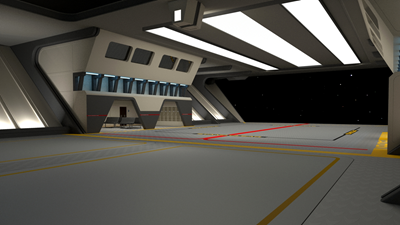 Among the largest locations aboard the vessel, the Shuttlebay of the Crossfield III Class is a massive, open area assigned the task of launching the ship's auxiliary craft. Unlike most of its predecessor explorer typed vessels, which typically utilize multiple bays, the Crossfield III incorporates a single, centralized Shuttlebay within its stardrive superstructure. This facility is currently dedicated to the storage and deployment of the ship's shuttlecraft complement, providing a streamlined hub for short-range transport and scouting missions.
The Shuttlebay is managed by the Flight Deck Operations Officer and is constantly monitored from a nearby Control Room. Landing procedures are strictly regulated, with the ship's computer frequently assuming control of incoming craft during their descent to ensure a safe transition into the bay. Shuttlecraft enter and depart the facility through large exterior airlock doors. These colossal structures are constructed of triple-layered duranium, featuring an interior of lightweight neofoam sheeting set within an expanded tritanium framework to support the massive structural load. Whenever the exterior doors are cycled open, high-intensity containment fields engage to maintain atmospheric integrity and pressure within the bay.
Shuttlebay 1
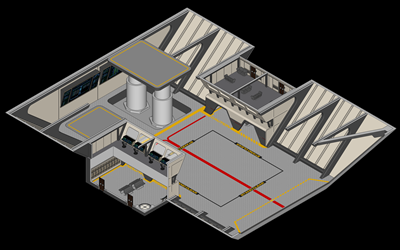 The Shuttlebay of the Crossfield III-class serves as the vessel's primary nexus for auxiliary flight operations, characterized by a massive, open-concept hangar deck designed to facilitate the rapid deployment and recovery of short-range shuttlecraft. Situated within the ship's superstructure, this centralized facility provides a streamlined hub for logistical support, scouting missions, and personnel transport, differing from larger classes that utilize multiple disparate bays. The deck architecture features reinforced angled bulkheads and high-intensity overhead lighting arrays to provide maximum visibility during complex landing maneuvers.
The hangar deck is organized into specific operational zones, including a primary launch and landing area marked by high-visibility "Stand Clear" safety lines and a central red guidance strip to assist pilots in proper alignment. The landing surface is composed of textured, heavy-duty deck plating designed to withstand the thermal stress and physical impact of auxiliary craft operations. For logistical efficiency, the bay includes integrated elevator platforms and specialized cylindrical docking pylons capable of securing various shuttle configurations for maintenance or prolonged storage.
Flight operations are managed from a dedicated multi-level control room overlooking the hangar floor. This command center is equipped with a battery of high-resolution strategic displays and monitoring consoles that track arrival and departure schedules, atmospheric pressure, and the status of the primary launch doors. Personnel awaiting transport or monitoring operations from the floor level have access to protected seating areas and staging zones recessed into the bulkheads.
The primary interface between the Shuttlebay and the vacuum of space is a colossal set of exterior airlock doors. These doors are engineered from triple-layered duranium and reinforced with a tritanium framework to maintain structural integrity under extreme pressure differentials. To protect the crew and equipment during active flight cycles, high-intensity atmospheric containment fields — visible as a blue shimmer across the bay aperture — engage whenever the physical doors are retracted. This allows the bay to remain pressurized even while the hangar is exposed to the space environment, ensuring that flight deck crews can continue operations without the need for full environmental suits.
Shuttlecraft
Shuttlecraft serve as the primary auxiliary workhorses of Starfleet, engineered to execute short-range and localized assignments that do not require the massive resources of a starship. Although they lack the expansive scale and long-term endurance of a Runabout, these vessels are fully warp-capable, allowing them to traverse the distances between neighboring star systems with ease. Their operational utility is centered on the efficient transport of cargo and personnel, as well as the delivery of away teams to planetary surfaces or orbital facilities. Due to their ubiquitous nature throughout the Federation, a standard lifecycle for these craft often involves a transition from active Starfleet service to civilian ownership; as the military fleet adopts newer, more advanced designs, the reliable shuttles of previous generations are frequently decommissioned and repurposed for private or commercial use.
Type 47 Shuttlecraft
 | |
| Affiliation: | Federation Starfleet |
| Length: | 12 meters |
| Width: | 5 meters |
| Height: | 3.1 meters |
| Crew: | 3 personnel 6 evacuation |
| Speed: | Warp 8.7 |
| Armament: | Phaser Arrays Photon Microtorpedoes |
| Defenses: | Deflector Shields Reactive Armor |
Overview
The Type 47 was envisioned as a high-performance multi-role auxiliary craft, specifically engineered to provide rapid interstellar transit and away-mission support where larger starships might be too conspicuous. Measuring 12 meters in length, the airframe prioritizes both habitable volume and structural survivability. The interior features a centralized forward pilot station complemented by four supporting stations and a rear command chair, accommodating a full crew of six. Utilizing a programmable matter hull, the interior layout can be instantly reconfigured from a passenger transport to a scientific research platform or a medical evacuation unit. Despite its compact size, the Type 47 is designed for sustained operations, carrying approximately three days of emergency rations and robust life-support systems for its complement.
Capabilities
Propulsion is a primary strength of the Type 47, which utilizes a high-efficiency Warp Drive and advanced subspace field repeaters to maintain high warp velocities. These systems allow the shuttle to achieve impressive speeds for an auxiliary craft, and recent experimental refits have even seen the integration of pathway drive technology into specialized units. At sublight speeds, vectored impulse thrusters provide the agility once reserved for dedicated fighters, enhanced by holographic control panels that offer the pilot near-instantaneous feedback. To ensure mission longevity, the vessel features long-range communications and advanced sensor suites, though its electromagnetic signature must be carefully managed during stealth operations.The Type 47 is far more formidable than the shuttlecraft of previous centuries, incorporating several layers of active and passive protection. Its primary defense consists of a high-capacity Deflector Shield array supplemented by a standard Federation Cloaking Device, allowing for undetected movement into hostile territory. In emergency scenarios, specialized protective shielding can deploy over the shuttle's viewports to protect the airframe and crew during crash landings or high-velocity atmospheric entry. Offensively, the Type 47 is armed with a dual-mounted 32nd Century Federation Phaser Beam Array and a forward-mounted launcher capable of firing Photon Torpedoes. This offensive bite, combined with its ability to maintain a constant link with a mothership like the Sulaco, ensures the Type 47 remains a critical tactical asset on the front lines of 3189.
Categories: No categories found