Medical & Scientific Facilities
Created by Captain Emiul Thikaik on Sun Feb 22nd, 2026 @ 5:58pm
Medical Facilities
Overview
 The Medical Department aboard the Crossfield III Class is charged with providing comprehensive healthcare to the ship's company and attached personnel. Given the diverse range of lifeforms encountered during multi-dimensional and deep-space missions, these facilities are equipped with an extraordinary range of medical tools. The department is principally located across two major facilities: the primary Sickbay on Deck 4 and a secondary Infirmary on Deck 12.
Sickbay maintains of the following sections aboard a starship:
- Treatment: This is the largest section, containing a circular array of diagnostic biobeds. Each biobed is orthopedically designed and incorporates biofunction sensors that monitor vital signs such as heart rate, temperature, and neural activity.
- Laboratory: This section features advanced bio-assay and lifeform analysis hardware. It includes workstations for chemical analysis and a computer desk where the CMO can conduct staff briefings or cross-reference findings with the Starfleet medical database.
- Surgical Bay: Centered in the ward is the primary surgical biobed, equipped with a Surgical Support Frame (SSF) or "clamshell". The SSF maintains a sterile environment through forcefield generation and can automate the administration of intravenous medications or provide cardiovascular support.
Medical personnel rely on a suite of sophisticated instruments to provide care both within the Sickbay and during away missions. The biobeds used throughout the ship are orthopedically designed and feature integrated sensor arrays that provide a constant stream of vital data to the Medical Display and the AIMS medical sub-processors. For field operations, medical staff are issued medikits, hyposprays for aerosolized medication delivery, and various specialized scanners such as pulmonary and cortical probes to treat a wide array of neurological and respiratory conditions.
The Crossfield III Class maintains a standard medical complement of physicians, medical technicians, and registered nurses, with all mental health and counseling duties having been returned to the direct responsibilities of the Chief Medical Officer. To support these personnel, the ship is equipped with a morgue for the secure storage of deceased individuals and a suite of advanced hardware. In the event of a large-scale disaster or humanitarian crisis, the ship’s Cargo Bays and Shuttlebays can be rapidly converted into secondary triage centers using specialized, quick-deploy emergency hospital modules.
Sickbay
 Located on Deck 4 within the center of the Primary Hull, Sickbay serves as the main medical complex for the Crossfield III Class and is among the most defended locations aboard the vessel. Constantly manned by the medical team and integrated with the AIMS AI, the facility utilizes advanced 32nd Century refit technology, including built-in holographic projectors that support the Emergency Medical Hologram (EMH) during patient treatment.
Sickbay features a specialized circular layout designed to maximize efficiency and patient care, organized into three primary sections. The main ward occupies over half of this circular space and contains six numbered Biobeds arranged in a radial pattern. Orthopedically designed, these Biobeds feature sophisticated internal sensors that conduct detailed physiological analyses to diagnose afflictions. These sensors transmit real-time vitals to biofunction monitors, the AIMS core, and handheld units like medical tricorders. For intensive interventions, each bed can integrate a Surgical Support Frame, or "clamshell," which creates a sterile field and automates treatments such as medication injections, cardiovascular resuscitation, and regenerative field therapy.
 A specialized surgical chamber is situated within the complex, intended for complex or emergency invasive procedures. This chamber features a central primary Biobed equipped with an overhead cluster of diagnostic sensors (the most advanced in the ward) capable of gathering subcellular data. Upon the initiation of surgery, a localized containment field and a dedicated environmental system engage to ensure total sterilization and protect the patient from microorganisms. A transparent viewport behind the central nurse's station allows staff to observe these procedures without interference, though the panel can be made opaque for privacy.
The Chief Medical Officer’s office and a small waiting area are connected to the main ward. The office features a large desk with a standard computer terminal for managing medical records and research, as well as a wall-mounted display for high-level patient monitoring. Designed for comfort during long shifts, the office includes a replicator and seating for private consultations. Adjacent to the office, a small corridor provides direct access to the medical laboratory, where staff conduct lifeform analysis and synthesize medications.
Infirmary
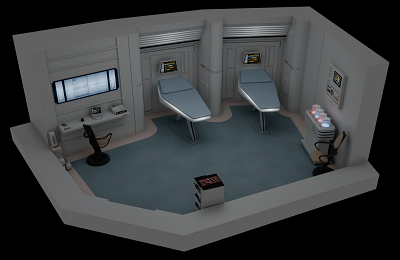 Located on Deck 12, the Infirmary serves as a vital secondary medical treatment center aboard the Crossfield III Class, acting as a high-speed supplement to Sickbay on Deck 4. Established to provide rapid emergency care in situations where a patient cannot be safely transported across the ship’s vertical displacement, this facility ensures medical redundancy for the engineering and secondary hull sections. While more spartan in its configuration than the primary center, the Infirmary is a fully capable healthcare node usually staffed by a nurse or medic, though the ship's Emergency Medical Hologram can be instantly deployed to the ward should a physician's expertise be required.
The layout of the facility is optimized for efficiency and isolation, featuring its own dedicated life-support system that allows the area to be quarantined from the rest of the vessel during biohazard emergencies without interrupting broader starship operations. The ward is currently outfitted with twin recovery Biobeds, each featuring integrated biofunction monitors that provide medical staff with real-time telemetry on a patient’s vital signs. Although the Infirmary does not house a dedicated surgical suite, medical sensor clusters are installed directly into the bulkheads to provide diagnostic data comparable to the primary Sickbay’s intensive care units.
Beyond immediate treatment, the room incorporates a compact research and administrative station. This area consists of an integrated computer terminal capable of conducting limited medical investigations and lifeform analyses, supported by priority uplinks to the Starfleet Medical databases and the ship’s computers. This streamlined medical environment allows the Crossfield III to manage minor diseases and routine physicals locally, reserving the primary Sickbay for major surgeries and complex multi-species research.
Scientific Facilities
Overview
The Crossfield III Class remains the pinnacle of Starfleet’s mobile research initiatives, engineered from the ground up as a multi-disciplinary laboratory. Its most formidable feature is the ability to sustain over 300 discrete scientific operations simultaneously, a capability facilitated by its modular laboratory architecture and the massive processing power of the ship's computer network.The ship’s unique concentric-ring saucer design allows for highly compartmentalized research environments, ranging from high-energy physics and stellar cartography to exobiology and quantum mechanics. In addition to its specialized Spore Drive Engineering Bay, the vessel features 32nd Century upgrades like nanogel control interfaces and multiphasic scanning arrays. These facilities are linked by a high-capacity Isolinear Computer Core that integrates centuries of data, making the Crossfield III second only to the U.S.S. Discovery for deep-space exploration and multi-dimensional analysis.
Hydroponics Laboratory
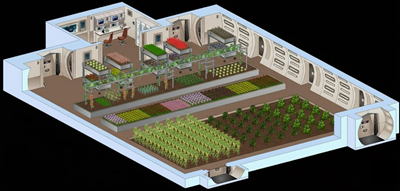 The Hydroponics Lab aboard the Crossfield III Class serves as the primary botanical and agricultural facility, playing a critical role in both the vessel’s ecological balance and the crew's nutritional requirements. These labs are managed by specialized science and botany officers who oversee the cultivation of a diverse range of plant life, including fresh produce for shipboard consumption and exotic flora for biological research. The facility is organized into several large soil-based planters and vertical growth racks, all maintained by integrated climate control systems that simulate various planetary environments.
A central management station is located at the far end of the lab, featuring high-resolution monitoring consoles that track atmospheric moisture, nutrient distribution, and UV light cycles. This duty station is enclosed by a glass partition, providing the botanical team with a clear view of the growth beds while maintaining a sterile environment for data analysis. The lab features multiple entry points, allowing for the efficient transfer of harvested materials to the ship’s galleys or specialized science laboratories for further study.
Complementing the standard agricultural output is a secondary, highly specialized facility known as the Mycelial Navigation Grove. Unlike the standard hydroponics lab which focuses on traditional flora, the Grove is dedicated to the cultivation and maintenance of Prototaxites Stellaviatori, the mycelial spores essential for the ship’s unique propulsion system. This grove acts as a biological interface for the Spore Drive, requiring precise energetic and environmental conditions that differ significantly from those of the standard food-producing beds. Together, these facilities ensure that the Crossfield III remains self-sufficient during long-term exploration while sustaining its advanced navigational capabilities.
Laboratory (Configurable)
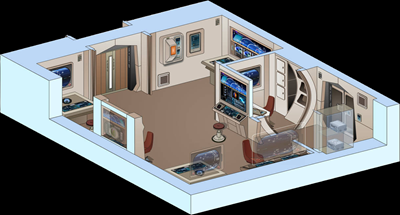 The distribution of the Crossfield III Class's scientific facilities represents a radical departure from traditional Starfleet design, optimizing the vessel for its role as the fleet's premier multi-disciplinary research platform capable of managing 300 discrete operations simultaneously. By placing general-purpose Science Laboratories within the core structure on Decks 3 and 5, and extending them into the secondary hull on Deck 16, the class achieves a decentralized architecture that allows for localized access to critical ship systems while providing controlled conditions for experimental and observational duties. These saucer-based labs utilize modular analysis tables equipped with multi-spectral sensors and localized isolation forcefields to ensure that experimental subjects remain contained within a secure environment.
Further down the vertical axis, the laboratories located on Deck 16 in the engineering hull serve a specialized purpose focused on high-energy physics and mycelial mechanics. Their location adjacent to the horizontal Warp Cores and Impulse Engineering provides these labs with direct access to high-output Electro-Plasma System (EPS) taps, essential for experiments requiring massive energy surges or manipulation of the mycelial plane. Due to the critical nature of these operations, multiple safeguards are in place to protect the ship and crew from research projects run amok. Each laboratory features a dedicated life-support connection and reinforced bulkhead forcefield generators, allowing the ship's AI to quickly isolate a facility in an emergency, such as a viral outbreak or containment breach. In the event a biological lifeform escapes confinement, anesthetic gas can be released to contain the sample; in a worst-case scenario where all other options are exhausted, the laboratory can be vented into space or jettisoned to prevent catastrophic energy fluctuations from cascading into the primary propulsion systems.
Starfleet Sciences has authorized five basic laboratory configurations for usage aboard the class, ensuring each facility adheres to a standardized infrastructure that incorporates built-in holographic emitters to support interactive data visualizations. While specific modules may limit access to specialized equipment, every laboratory includes a large primary analysis table for detailed examination of subjects, which can be isolated via forcefield in an emergency. Multiple workstations are fitted throughout each lab, with the majority of terminals built into the bulkheads and some incorporating secondary analysis tables to supplement the primary console. Located around the periphery of the room, multiple storage compartments house equipment, reagents, and supplies for diverse scientific disciplines. This complex arrangement of facilities ensures that whether the mission involves mapping a nebula or testing propulsion theories, the Crossfield III remains the most capable discovery vessel in the Federation’s current service.
Laboratories in Use on the Crossfield III Class | |||
| 1 | |
None | Anthropology & Archaeology Laboratory General Science Laboratory |
| 2 |  |
Large Holographic Tank | Astrophysics/Physics Laboratory Mycelial Physics Laboratory Planetology Laboratory |
| 3 | 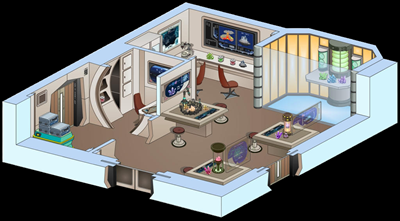 |
Isolation Room | Botany Laboratory Chemistry Laboratory Engineering Laboratory Geology Laboratory Metallurgy Laboratory |
| 4 | 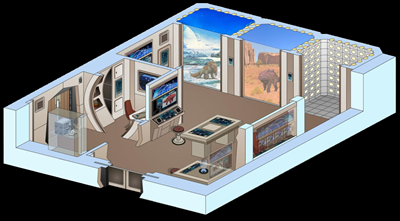 |
Multiple Holographic Observation Cells | Biology/Xenobiology Laboratory Cybernetics Laboratory Medical Laboratory Zoology Laboratory |
| 5 | 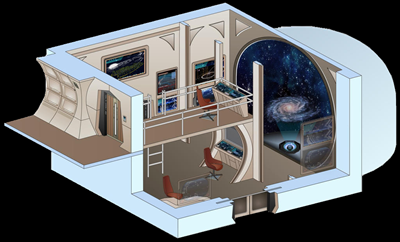 |
Large Holographic Tank Multi-Level |
Astrometrics Stellar Cartography |
Library Access Laboratory
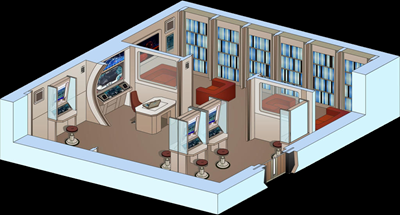 Located on Deck 5 within the primary hull, the Library serves as a central hub for scholarly and scientific research aboard the Crossfield III Class. By providing integrated access to both physical archives and vast digital repositories, the facility offers a comprehensive environment for researchers to synthesize complex data. In an era where information is nearly infinite, the Library maintains a curated collection of physical reference materials that can be utilized within the premises for tactile analysis or as backup in the event of local computer disruptions.
To ensure the crew can effectively navigate the overwhelming volume of available data, the facility is overseen by a specialized Librarian. This research professional is trained to assist personnel in maximizing the utility of the Library Computer and the direct high-speed links to the Starfleet Galactic Memory Bank at Memory Alpha. The architectural layout of the Library is designed to support diverse learning styles, featuring shielded quiet zones for private study, common areas for interdisciplinary group collaboration, and dedicated workstations that interface directly with the ship's computer for real-time research visualization.
Sensor Maintenance Room
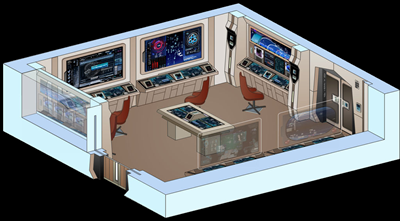 The Sensor Maintenance Room aboard the Crossfield III Class serves as the primary technical hub for the calibration, repair, and oversight of the vessel's extensive external and internal sensor arrays. Situated within the Science Department's infrastructure, this facility is critical for maintaining the high-resolution data streams required for both stellar cartography and tactical operations. The room’s layout features a sophisticated array of wall-mounted diagnostic displays and peripheral workstations, which provide technicians with real-time telemetry on the status of the lateral, upper, and lower sensor clusters.
The focal point of the facility is a central, freestanding diagnostic table that projects three-dimensional holographic representations of active sensor sweeps and hardware configurations. This table allows specialist teams to identify minute interference patterns or hardware degradation within the ship's sensor palettes. Multiple ergonomic duty stations surround this central hub, each equipped with dedicated data terminals for managing the complex algorithms that filter subspace noise and environmental distortion.
To facilitate immediate repairs, the room includes specialized equipment racks and localized processing units that allow for the bench-testing of individual sensor components before they are reinstalled into the ship's hull. Integrated overhead lighting and a reinforced structural design maintain a focused environment for technical personnel. Access is restricted via biometric-locked doors to ensure the security of the ship's primary surveillance and data-gathering equipment.
Categories: No categories found